
Why Most Small Business Websites Don't Generate Leads (And It Has Nothing to Do With Traffic)
Getting visitors but not enquiries? The problem is almost certainly not traffic — it is how your website is built to convert the people already showing up.
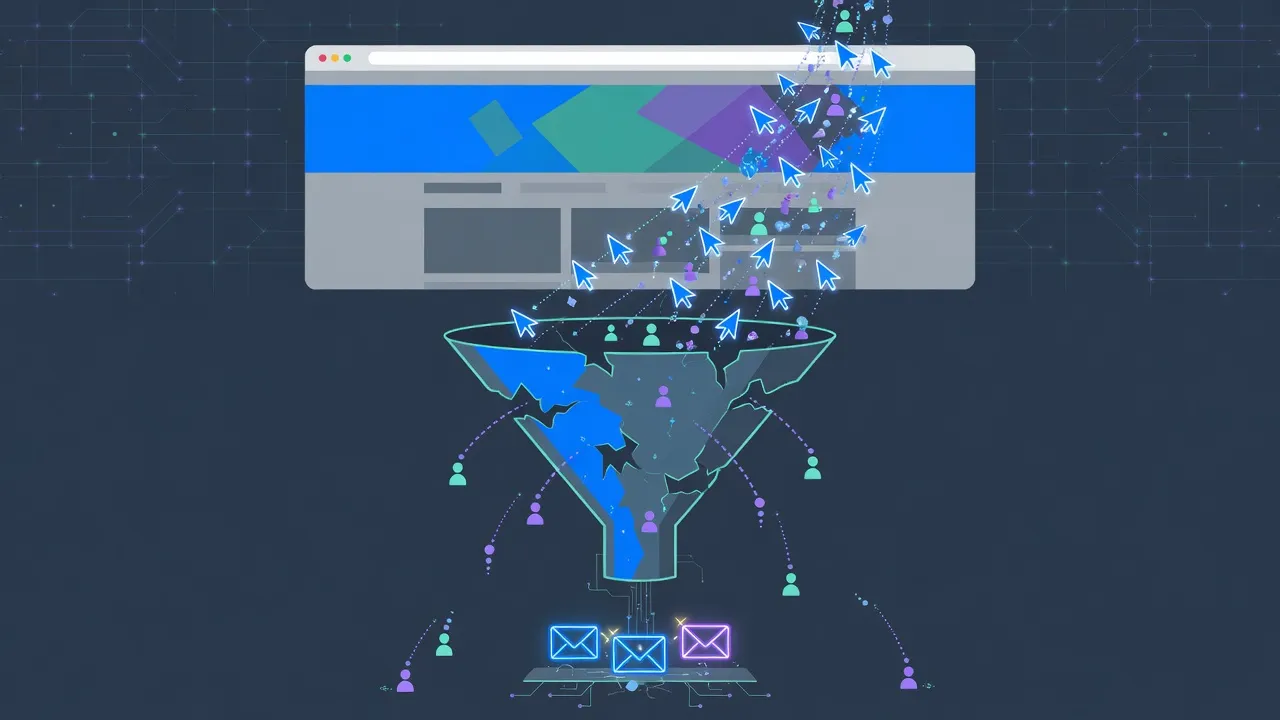
You've got a website. People are visiting it. And yet — the enquiries are barely trickling in.
The instinct is to assume it's a traffic problem. Get more visitors, get more leads. But here's the uncomfortable reality: if 97 out of every 100 people are already arriving at your site and leaving without contacting you, sending more people to the same system just means more missed opportunities.
The average small business website converts between 1–3% of visitors into leads. That means 97–99% of people who visit your site leave without taking any action. The gap between a 1% conversion rate and a 3% one isn't about traffic volume. It's about how your website actually works.
The Digital Brochure Problem
Most small business websites were built to be looked at, not to convert visitors into customers. They explain what a business does. They have a services page, an about page, maybe a contact form tucked in the footer. They represent the business well.
But they don't work for the business.
This is the digital brochure problem. Your site looks fine — but it was never designed as a system that moves a stranger (who knows nothing about you yet) through the journey that ends with them pressing "get in touch."
What a Lead-Generating Website Actually Looks Like
The websites that consistently generate enquiries don't look radically different from the ones that don't. The difference is in the architecture — the invisible logic that guides every visitor toward a decision.
One clear job per page. Every page on your site should have a single primary goal. Your homepage converts a visitor into an enquiry or email subscriber. Your services page moves someone from interested to ready-to-contact. When a page tries to do five things, it does nothing.
A trust sequence, not a features list. Visitors arrive with one core question: can I trust these people? Most websites answer with "here's what we do." A converting website answers with specific results ("we helped a Wellington hospitality group increase online reservations by 60%"), real social proof with named clients, team photos, and the kind of detail that signals genuine credibility.
Genuine mobile-first design. Mobile traffic accounts for roughly 65% of visits on most small business websites in 2026 — yet mobile converts at nearly half the rate of desktop (1.82% vs 3.14%). That gap exists not because mobile users don't buy, but because most websites make it harder to enquire on a phone: tiny buttons, awkward forms, slow loading times. "Mobile-friendly" and "mobile-first" are very different things.
Zero-friction contact. If your contact form asks for more than three fields, you're losing leads. Name, email, and one qualifying question. Every additional field is a reason to abandon the form. Your phone number should be tap-to-call. Your address should open Maps in one tap.
Tracking that actually tells you something. Do you know which page most enquiries come from? Which traffic source converts best? Where in the journey most visitors drop off? Without clean event tracking and conversion goals set up properly in Google Analytics 4, you're optimising blind — making changes and hoping for the best.
Info
A useful benchmark: if you're not measuring conversion rate by page and by traffic source, you cannot know where your site is leaking leads — and you cannot fix what you cannot see.
The Part Nobody Tells You
Here's where it gets honest.
Everything above is real, correct, and worth acting on. Most business owners who read guides like this will nod, tweak a few things, and find the needle barely moves.
That's because the difference between a website that converts and one that doesn't is rarely one change. It's the accumulation of dozens of small decisions — made correctly, consistently, and monitored over time.
It's having tracking set up properly from day one. It's your contact form feeding directly into a CRM so no lead disappears into an inbox nobody checks. It's load times that don't frustrate mobile users. It's understanding, from actual data, which pages are doing the work — and which are quietly haemorrhaging visitor interest.
Most websites were built as a one-time project. But a lead-generating website is an ongoing system. The real cost of a "set and forget" site isn't what you paid to build it — it's the leads you don't know you're losing, month after month, because nobody is watching the data.
Tip
Before spending another dollar on ads or SEO, audit your contact form. Reduce it to three fields maximum: name, email, and one qualifying question. For most small businesses, this single change produces a measurable uplift in enquiry rate within weeks.
The Businesses Getting It Right
The businesses in New Zealand consistently generating leads online aren't necessarily the ones with the biggest budgets. They're the ones treating their website as a living conversion system — one that's connected to their CRM, has clean tracking, and gets reviewed regularly against actual performance data.
They know their conversion rate. They know where it leaks. And they fix those leaks before spending another dollar on traffic.
This is exactly the kind of system we help businesses build at CNEX — because we've seen too many well-designed websites quietly do nothing, and the difference almost never comes down to design. It comes down to architecture and attention.
If you're getting traffic but not leads, it might be worth a conversation about what's actually happening under the hood.
Key takeaways:
- 97–99% of small business website visitors leave without taking action
- The gap between 1% and 3% conversion rates is a systems problem, not a traffic problem
- Mobile converts at nearly half the rate of desktop — and this gap is almost entirely fixable
- A lead-generating website is an ongoing system, not a finished project
Getting visitors but not enquiries? Talk to our team about a conversion audit — we'll show you exactly where your site is losing leads and what to do about it.
Written by
CNEX Team
Building the next generation of enterprise software at CNEX. Passionate about AI, cloud-native architecture, and elegant solutions to complex problems.
Related articles
How Auckland Clinics Lose Bookings Between 5pm and 9am (With the Maths)
Most Auckland clinics only answer the phone for about a quarter of the week. Here's the maths on what that costs, the four common leak points, and what to fix before you buy anything.
What an AI Receptionist Actually Costs in NZ (2026) — and When It's Worth It
Real subscription and done-for-you pricing from named NZ/AU providers, the hidden costs nobody quotes, a worked example for a clinic and a builder, and when you shouldn't buy one at all.
Why Most NZ Businesses Lose the Leads They Already Paid For
You're spending money to generate leads. But if your follow-up is broken, you're paying for enquiries that go nowhere. Here's what's actually happening — and how to fix it.